TECHNICAL SEO
Win the Technical SEO Foundation Competitors Ignore.
For established sites that aren’t ranking despite having quality content. We fix the engine under the hood.
A technical SEO consultant fixes the underlying structure of a website so search engines can crawl it, render it, understand it, and rank it. Content and links get most of the attention, but they sit on top of a foundation — site speed, crawlability, indexation, architecture, and structured data. When that foundation is broken, even excellent content underperforms.
Most businesses don’t have a content problem. They have an engineering problem disguised as a content problem. They publish consistently, build links, and still stall — because render-blocking scripts, wasted crawl budget, duplicate URLs, or missing schema are quietly capping everything else.
I’m Zohaib Munawar, founder of ZACODERS. With a background in full-stack development (React, Next.js) and 10+ years across SEO and web engineering, I approach technical SEO the way an engineer approaches a slow system: diagnose the real bottleneck, fix it at the source, and measure the lift. The result is a site that’s easier to crawl, faster to load, and more likely to be cited — by Google and by AI search engines alike.
What Is a Technical SEO Consultant?
Google can't rank what it can't crawl.
Technical debt, slow speeds, and poor architecture are invisible barriers standing between your content and your customers. Even the best content fails when your site’s foundation is structurally compromised.
Strategic Engineering for Visibility
We address the specific technical nodes that drive algorithm confidence.
Core Web Vitals
Performance optimization focusing on LCP, FID, and CLS to ensure your site exceeds Google's "Good" threshold.
Crawl & Index Health
Advanced robots.txt management, sitemap optimization, and internal link restructuring to guide bot efficiency.
Schema Markup
JSON-LD implementations that communicate entity relationships directly to Search Engines and AI aggregators.
Site Architecture
Logical taxonomy and URL structures designed for both user navigation and programmatic discovery.
AI-Search Readiness (GEO)
Optimizing for Generative Engine Optimization. We ensure your data is clean and structured for LLM retrieval and citation in AI-driven search results.

Professional Services Firm
A leading legal firm struggled with stagnant growth despite constant blogging. Our audit revealed critical crawl budget waste and render-blocking scripts.
Proven recovery from technical debt.
Fixing technical SEO isn’t just about checkboxes; it’s about clearing the path for growth. We reduced this client’s page load time by 3.2s, resulting in immediate crawl frequency spikes and a 65% improvement in organic sessions within the first quarter.
Real Impact
The Technical Issues Quietly Capping Your Rankings
01
Crawl budget waste
Bots have a finite budget. If they burn it on infinite filter URLs, paginated archives, broken links, and thin pages, they never consistently reach the pages that matter. Fixing crawl efficiency often beats new content for ranking gains.
Render-blocking and slow Core Web Vitals
LCP, INP, and CLS are real ranking and conversion factors. A site that fails Google's "Good" threshold loses algorithmic confidence and real users who bounce before the page loads.
02
Indexation chaos
Duplicate content, missing or conflicting canonicals, accidental noindex directives, and messy parameters cause Google to index the wrong pages — or none. A single stray noindex can quietly delete a page from search.
03
Weak or missing structured data
Without clean JSON-LD, search engines guess what your pages mean. With it, you become eligible for rich results and far easier for AI systems to understand and cite.
04
Illogical architecture
Flat or tangled structures dilute link equity and confuse crawlers. A logical hierarchy concentrates authority where it earns rankings.
05
Technical SEO has quietly become the foundation of Generative Engine Optimization (GEO) — being cited inside AI answers from ChatGPT, Perplexity, Gemini, and Google’s AI Overviews. These systems can only cite what they can cleanly parse and confidently understand, which makes structured data, clean HTML, fast rendering, and unambiguous architecture more valuable than ever.
I prepare your site to be machine-readable first: comprehensive schema defining your entities and their relationships, server-rendered content that doesn’t hide behind heavy JavaScript, and a structure that lets an LLM extract a clear, quotable answer. The sites engineered for retrieval today will own the citations tomorrow — and most competitors haven’t started.
Built for AI Search, Not Just Google
Our Methodical Approach
Audit
Comprehensive deep-dive using programmatic crawlers to identify every bottleneck and error.
01
Repair
Hands-on implementation to resolve 404s, redirect chains, and server response issues.
02
Optimize
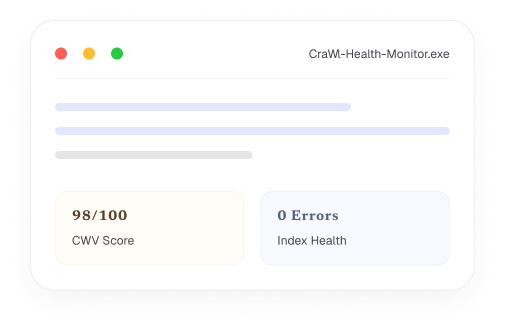
Refining CWV scores and injecting high-value Schema to maximize SERP feature visibility.
03
Monitor
Ongoing health checks and log file analysis to ensure your engine stays performance-ready.
04
Who Needs Technical SEO
Technical SEO delivers the highest return for established sites that have invested in content and still aren’t seeing results. If you publish regularly, have decent backlinks, and remain stuck on page two, the bottleneck is almost always under the hood.
It’s especially critical after a migration or redesign (when rankings drop without an obvious cause), for large sites where crawl budget matters, for ecommerce with thousands of URLs, and for any business moving to a JavaScript framework where rendering can break indexing. If your site is brand new with little content, publishing useful pages comes first — and I’ll tell you that honestly.
Frequently Asked Questions
How does site speed impact my actual rankings?
Google utilizes Core Web Vitals as a ranking signal. Sites that fail the “Good” threshold often see significant volatility and lower conversion rates because of poor user experience. Our speed optimization directly correlates to higher retention and improved algorithm confidence.
Why aren't my new pages being indexed quickly?
Index lag is often a symptom of “crawl budget” waste. If bots spend too much time on low-value pages (thin content, infinite filters, broken links), they won’t reach your new content. We fix your crawl efficiency to ensure new pages are found and indexed within hours, not weeks.
What is the role of Schema markup today?
Schema is the bridge between human content and machine understanding. In the age of AI search (SGE/GEO), properly implemented Schema allows search engines to understand the exact context of your services, increasing the likelihood of rich snippets and AI citations.
What's the difference between technical SEO and on-page SEO?
On-page optimizes content — titles, headings, copy, internal links. Technical optimizes the infrastructure that lets engines access and trust that content — speed, crawlability, indexation, architecture, schema. Technical issues silently undermine on-page work, so the foundation usually comes first.
How do I know if I have a technical SEO problem?
Common signals: new pages take weeks to index, rankings dropped after a redesign/migration, slow on mobile, traffic plateaued despite publishing, or Search Console shows errors you don’t understand. A crawl audit confirms it.
Is technical SEO a one-time fix or ongoing?
Major repairs are largely one-time, but health drifts as a site grows. Most sites benefit from an initial deep fix plus periodic monitoring (log-file analysis, Core Web Vitals).
Can technical SEO recover a site that lost rankings?
Often yes — drops after a migration or platform change are frequently technical (broken redirects, lost canonicals, blocked resources). An audit finds the regression and a recovery plan restores it.
Will fixing technical SEO increase conversions too?
Frequently. Faster pages, cleaner architecture, and better mobile performance improve UX directly — the same fixes that please Google reduce bounce and lift conversions.
Ready to fix your SEO foundation?
Don’t let technical debt hold back your growth. Schedule a complimentary crawl audit and see exactly what’s blocking your site from Page 1.